Customer Advisory: Middle East Shipping Disruption (Update 5)

Customer Advisory: Middle East Shipping Disruption (Update 5)

on 1st March, 2026

Customer Advisory: Middle East Shipping Disruption (Update 5)
Middle East Shipping Disruption – Weekly Update

Published on: Mar 13, 2026 at 17:23 AEST

Dear Valued Customers,

As we close out the week, we would like to provide a further update on the evolving situation in the Middle East and its impact on global shipping services.

Following the escalation of conflict in the region, ocean carriers continue to implement emergency operational measures to protect vessels, crew and cargo. These actions are affecting services into the Persian Gulf and surrounding markets and have resulted in booking restrictions, voyage adjustments and the introduction of emergency carrier surcharges.

While the situation remains fluid, the key developments currently impacting shipments into the region are outlined below.


Market Snapshot

Operational Status
Disruptions to shipping services into the Persian Gulf continue following the escalation of conflict in the region. Several carriers have restricted bookings while alternative routing and contingency service structures are being evaluated.

Carrier Measures
Multiple ocean carriers have introduced emergency operational surcharges, voyage termination provisions and fuel adjustments to manage increased risk and operational costs.

Customer Impact
Customers may experience transit delays, cargo diversions, increased freight costs and limited space availability while carrier networks stabilise.

Outlook
While contingency supply routes are being evaluated, the timeline for a return to normal services through the Strait of Hormuz remains uncertain.


Current Operating Environment

Ocean carriers remain focused on safely managing cargo already in transit while reassessing future service structures into the region.

Key conditions currently impacting trade include:

  • Suspension or restriction of some bookings into Persian Gulf destinations

  • Voyage diversions and schedule adjustments for vessels already at sea where security risks are elevated

  • Some carriers issuing “End of Voyage” declarations, allowing cargo to be discharged at the nearest safe port rather than continuing to the originally planned destination

  • Ongoing evaluation of contingency service structures and alternative routing models to maintain supply into the region

Given the evolving security environment across the Strait of Hormuz and surrounding shipping corridors, the timing for the resumption of normal Gulf services remains uncertain.

Carriers are continuing to monitor conditions closely and may adjust their operating networks further depending on developments.


Carrier Booking Restrictions

Several ocean carriers have implemented temporary booking restrictions for certain Middle East and Persian Gulf destinations while they review vessel routing and security conditions.

These measures are intended to stabilise vessel operations and allow carriers to safely manage cargo already in transit.

The scope of restrictions varies by carrier and service and may evolve as alternative routing options or contingency services are introduced.

Customers should expect limited space availability and potential service changes while carriers continue to assess operating conditions across the region.


Carrier Emergency Surcharges, Cost Recovery & Fuel Adjustments

Ocean carriers have begun implementing emergency surcharges and cost recovery mechanisms associated with the conflict and the operational adjustments required to maintain safe vessel operations.

These surcharges are being applied directly by carriers and will be passed through in line with existing contractual and tariff arrangements.

The following charges have been announced by carriers to date:

Carrier Charge Name Valid From 20′ Dry 40′ Dry 20′ Reefer 40′ Reefer Notes
ANL / CMA CGM Emergency Contingency Surcharge (ECS) 2-Mar-26 $2,000 $3,000 $4,000 $4,000 Applies to cargo moving to/from affected Middle East markets
ANL / CMA CGM Peak Season Surcharge (PSS) Immediate $1,000 Applies to Egypt reefer shipments
Hapag-Lloyd War Risk Surcharge (WRS) 2-Mar-26 $1,500 $3,000 $3,500 $3,500 Applied across affected Gulf services
MSC Change of Destination / Voyage Termination Fee (COD) 3-Mar-26 $800 $800 $800 $800 Applies where vessels terminate voyage and discharge cargo at safe ports
MSC Emergency Operational Surcharge (EOS) 5-Mar-26 $2,000 $3,000 $4,000 $4,000 Applies to shipments bound for affected Middle East ports
ONE Emergency Surcharge (EMS) 4-Mar-26 $1,200 $2,400 $2,200 $3,400 Applies across affected trade lanes
PIL Freight Adjustment Immediate Up to +100% Up to +100% Up to +100% Up to +100% Carrier applying rate increases rather than a formal surcharge
T.S. Lines Emergency Contingency Surcharge (ECS) 13-Mar-26 $400 Applies to selected Red Sea trades
Sealead War Risk Surcharge (WRS) 1-Mar-26 $40 $40 $40 $40 Applies across Middle East and Red Sea services

Additional surcharges or adjustments may be introduced by other carriers as operational conditions continue to evolve.


Emergency Fuel & Bunker Adjustments

In addition to the operational surcharges outlined above, several carriers have introduced Emergency Bunker Surcharges (EBS) in response to recent volatility in global energy markets.

These adjustments are linked to:

  • Increased fuel consumption resulting from longer sailing distances and vessel diversions

  • Rising global crude oil prices

  • Operational inefficiencies caused by network disruption and contingency routing

The table below summarises known emergency fuel adjustments announced by selected carriers across key trade lanes.
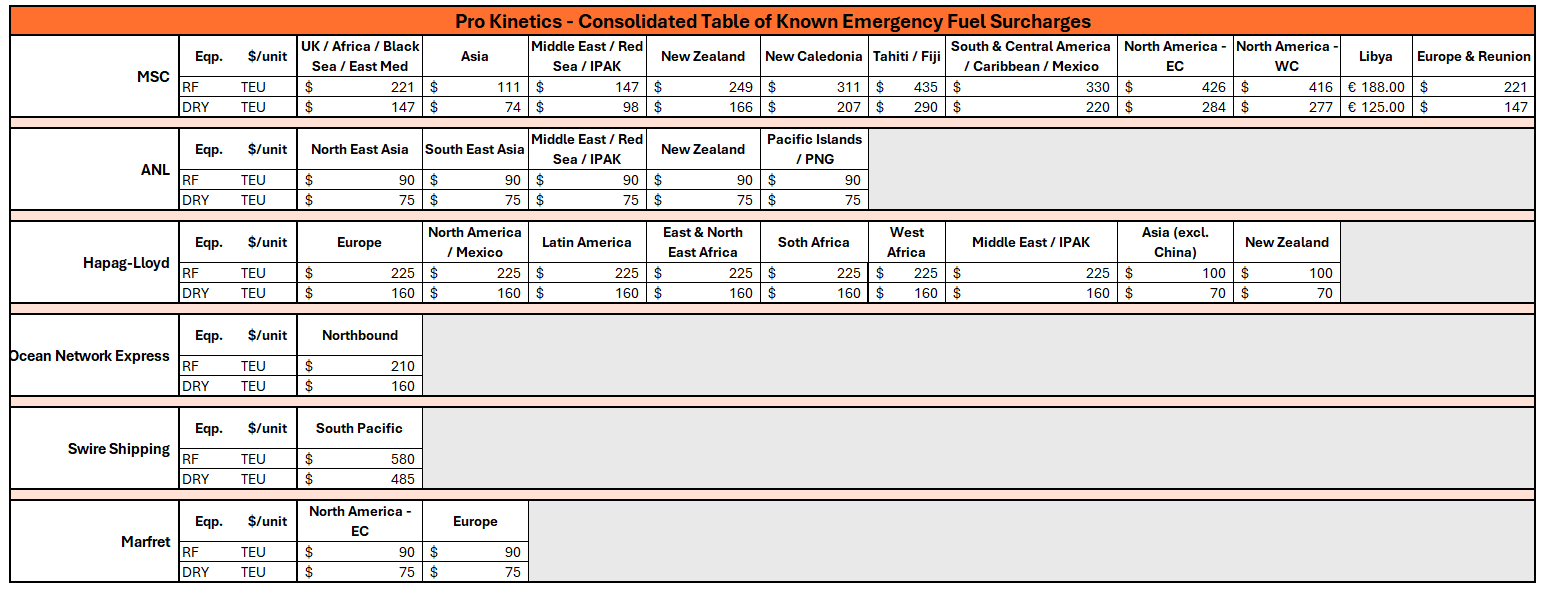
Note: The table summarises currently announced emergency fuel adjustments as at the date of publication. Rates may vary depending on trade lane, routing and equipment type and may be revised by carriers without notice.

These fuel adjustments are separate from operational surcharges and may be applied concurrently depending on carrier, routing and trade lane.


What This Means for Shipments

Customers may experience:

  • Transit delays where vessels are rerouted or diverted

  • Cargo discharge at alternative ports where voyage termination has been declared

  • Higher freight costs due to carrier surcharges and operational adjustments

  • Limited space availability while services remain restricted

These measures are being implemented by carriers to maintain safe vessel operations and protect cargo integrity while the security situation remains uncertain.


Pro Kinetics’ Approach

Pro Kinetics continues to monitor carrier advisories and operational developments across the region on a daily basis.

Our team is actively reviewing:

  • Cargo currently on the water

  • Shipments booked but not yet departed

  • Future orders scheduled to move through affected trade lanes

Where shipments are impacted, we are working directly with customers and carriers to manage the situation and assess available options.


Looking Ahead

While shipping services into the region remain disrupted, carriers are actively evaluating longer-term operating models to maintain supply into the Middle East.

Given the importance of the region to global trade, further service adjustments and commercial frameworks are expected to emerge over the coming weeks.

Pro Kinetics will continue to monitor developments closely and provide further updates as the situation evolves.

If you have questions regarding specific shipments or the potential impact on upcoming orders, please contact your Pro Kinetics representative.

Kind regards
Pro Kinetics


Published on: Mar 6, 2026 at 14:35 AEST

Customer Update – Middle East Shipping Disruptions & Carrier Surcharges

Dear Partners,

Following our previous updates, we would like to provide a further summary of the latest developments impacting shipping services into the Middle East and Persian Gulf region.

The ongoing conflict has resulted in several carriers implementing emergency operational measures, including booking suspensions, voyage terminations and the introduction of new war-related surcharges.

While the situation remains fluid, the key developments currently affecting shipments are outlined below.


Key Operational Updates

Booking Suspensions

A number of major carriers have suspended new bookings into the Middle East / Persian Gulf region, including:

  • COSCO
  • Hapag-Lloyd
  • Ocean Network Express (ONE)
  • Pacific International Lines (PIL)
  • MSC
  • ANL
  • Yang Ming (YML)

These suspensions primarily affect cargo destined for:

  • United Arab Emirates
  • Bahrain
  • Kuwait
  • Iraq
  • Qatar
  • Parts of Saudi Arabia
  • Oman and Yemen (in some cases)

MSC Voyage Termination

Mediterranean Shipping Company (MSC) has issued an “End of Voyage” declaration for cargo destined for the Persian Gulf.

This means containers already at sea may be discharged at the nearest safe port and placed into customer care, rather than continuing to their originally planned destination.

This effectively resets the original transport contract and requires new arrangements should cargo need to be forwarded to its final destination.


Announced Carrier Surcharges

(Applicable to cargo currently on the water and not yet arrived at final destination)

Carrier Charge Valid From 20’ Dry 40’ Dry 20’ Reefer 40’ Reefer
CMA CGM / ANL Emergency Contingency Surcharge (ECS) 2-Mar $2,000 $3,000 $4,000 $4,000
Hapag-Lloyd War Risk Surcharge (WRS) 2-Mar $1,500 $3,000 $3,500 $3,500
MSC Emergency Operational Surcharge (EOS) Immediate $2,000 $3,000 $4,000 $4,000
MSC Voyage Termination Fee 3-Mar $800 $800 $800 $800
PIL Freight Adjustment Immediate Up to +100% Up to +100% Up to +100% Up to +100%

Additional surcharges or adjustments may be introduced by other carriers in the coming days as the situation develops.


Returned Australian Meat Consignments

Due to disruption to air freight routes through the Middle East, some Australian chilled meat consignments are being returned to Australia, including cargo diverted mid-flight.

The Department of Agriculture, Fisheries and Forestry (DAFF) has advised that these consignments are being treated as distressed shipments, acknowledging their highly perishable nature.

To minimise delays and commercial impacts, the department has introduced an interim priority inspection process, including:

  • Priority inspection bookings for returned chilled meat consignments

  • Mandatory Manual Request for Inspection (RFI) submissions marked:
    “Priority – Returned Chilled Meats”

  • Biosecurity import permits required for consignments arriving without intact Australian government seals

  • All returned shipments must lodge import declarations in the Integrated Cargo System (ICS)

Returned consignments will undergo inspection to confirm seal integrity and ensure biosecurity compliance before they can be moved back to an approved export establishment for potential rework.

These interim arrangements are designed to expedite inspection and minimise delays for returned export meat consignments.


What Pro Kinetics Is Doing

Our team is actively reviewing all shipments impacted by these developments, including:

  • Cargo currently on the water

  • Cargo booked but not yet departed

  • Future orders scheduled to ship

Where shipments are affected, our team has already begun contacting customers to discuss potential solutions, including:

  • Alternative carrier options

  • Alternative routing or transhipment ports

  • Managing MSC voyage terminations where applicable

  • Assessing cost implications and available service options


Emergency Fuel & Bunker Charges

Some carriers have also begun introducing emergency fuel and bunker adjustments associated with route diversions and operational disruptions.

These charges will be passed through at cost on impacted shipments where applicable.


Our Commitment

We appreciate your patience as the industry navigates these rapidly evolving circumstances.

Our focus remains on maintaining supply continuity and protecting cargo integrity; particularly for time-sensitive meat and dairy shipments into the region.

We will continue monitoring carrier advisories closely and will provide further updates as additional information becomes available.

Thank you for your continued trust as we work through these challenging conditions together.

Kind regards,

The Pro Kinetics Team


Published on: Mar 4, 2026 at 10:47 AEST

MSC End of Voyage Declaration – Arabian Gulf

What This Means & How Pro Kinetics Is Supporting You

Following the advisory issued by MSC Mediterranean Shipping Company on 3 March 2026, an “End of Voyage” has been declared for all shipments destined for Arabian Gulf ports that are currently under MSC’s custody.

Link: https://www.msc.com/en/newsroom/customer-advisories/2026/march/important-notice-end-of-voyage-declaration-for-shipments-to-the-arabian-gulf

What This Means

  • All cargo currently at sea, at origin terminals, or in empty containers already released for packing and intended for the Arabian Gulf is impacted.
  • Vessels will divert to the next designated safe port.
  • Containers will be discharged at that location and placed at the consignee’s disposal.
  • A mandatory USD 800 per container deviation surcharge will apply.
  • All discharge, handling, storage, and related costs at the diversion port are for the cargo owner’s account.
  • Any onward movement to an alternative destination will require a new booking under new commercial terms.

This effectively resets the original transport contract to the Arabian Gulf.

Our Position How Pro Kinetics is Managing This For You

We understand the commercial and operational pressure this creates, particularly for temperature-controlled and time-sensitive cargo.

Pro Kinetics is actively:

1. Reviewing All Impacted Shipments

  • Cargo currently on the water
  • Containers at origin terminals
  • Empty units already positioned for packing

We are assessing each shipment individually to determine exposure and available recovery options.

2. Engaging Directly With Carriers

We are in direct contact with MSC and alternative carriers to:

  • Confirm diversion ports
  • Secure clarity on reefer monitoring and power availability
  • Explore re-forwarding options where viable

3. Evaluating Alternative Routing Strategies

Where possible, we are assessing:

  • Transhipment via unaffected hubs
  • Alternative carriers still servicing the region
  • Temporary diversion to stable intermediate markets

4. Protecting Cold Chain Integrity

For chilled and perishable programs, our priority is:

  • Minimising dwell time at diversion ports
  • Mitigating product deterioration risk
  • Supporting documentation for potential insurance or contractual claims

5. Direct Customer Coordination

Our team will be contacting affected customers individually to:

  • Outline the specific position of each shipment
  • Discuss commercial implications
  • Develop practical recovery plans aligned with your buyer commitments

Our Position

This represents an exceptional operational disruption beyond standard delay scenarios.

Pro Kinetics is actively assessing all impacts and exploring all available options in response to the evolving market conditions and carrier directives. We will continue to engage directly with affected customers and coordinate closely with the carriers to support workable solutions wherever possible.

Further updates will be provided as additional confirmations are received.

Sincerely,

The Pro Kinetics Team


Published on: Mar 2, 2026 at 07:53 AEST

Dear Valued Partners,

Further to our communication yesterday, we are providing a second update based on the latest confirmed actions from major carriers. The security environment across key Middle East shipping corridors remains volatile, and operational measures continue to be implemented to protect crew, vessels and cargo.

Security and Routing Environment

Conditions across the Strait of HormuzBab el-Mandeb, and the Suez Canal corridor remain unstable.

Carriers are avoiding high-risk areas where possible, holding vessels in safe locations, and diverting services away from traditional routes into the Middle East region.

Carrier Operational Updates – current as of 02/03 7:00am AEST

Maersk

  • Transits through the Strait of Hormuz and the Suez Canal are currently suspended.
  • Affected services are being rerouted via the Cape of Good Hope.
  • Ongoing monitoring with further operational adjustments expected.

CMA CGM

  • Vessels in or bound for the Persian Gulf have been instructed to remain in safe areas.
  • Suez Canal transits are suspended until further notice, with Cape diversions implemented where operationally feasible.
  • No bookings being accepted into the Middle East Region.

CMA CGM – Emergency Conflict Surcharge (ECS)

CMA CGM has confirmed the implementation of an Emergency Conflict Surcharge, effective 2 March 2026 (loading date and cargo on the water) until further notice.

Surcharge levels (USD):

  • 20’ Dry: $2,000
  • 40’ Dry: $3,000
  • Reefer / Special Equipment: $4,000

Applicable to: Iraq, Bahrain, Kuwait, Yemen, Qatar, Oman, UAE, Saudi Arabia, Jordan, Egypt (Ain Sokhna), Djibouti, Sudan and Eritrea.

Depending on origin and contract structure, these costs may be included within the freight rate.

MSC Mediterranean Shipping Company

  • Services through high-risk areas are being reviewed on a voyage-by-voyage basis.
  • Selected vessels are being delayed, diverted, or held outside risk zones depending on security assessments.
  • Network adjustments and transit delays should be expected where diversions via the Cape are required.
  • No bookings being accepted into the Middle East Region.

Hapag-Lloyd and other carriers

  • Hormuz transits suspended, with services redirected away from high-risk zones.

Operational Impact

  • Diversions via the Cape of Good Hope are expected to add approximately 10–14 days or more to transit times compared with traditional Suez routings however potentially not possible for the Arabian Gulf ports.
  • Schedule reliability remains low and subject to change at short notice.
  • Most carriers have now stopped accepting cargo for the Middle East; situation remains fluid.
  • Additional war-risk and operational surcharges are expected to remain in place while conditions persist. With carriers looking to roll out their surcharges in the coming days.

Pro Kinetics Actions

Pro Kinetics is actively reviewing all shipments impacted by the current situation, including:

  • Cargo already on the water
  • Shipments scheduled but yet to depart

Our team will be contacting affected customers individually to discuss the specific impact on their orders and to work through possible routing, timing or commercial solutions where available.

Customer Guidance

In the meantime, we recommend:

  • Reviewing orders yet to depart for potential re-routing or new markets in Asia or elsewhere.
  • Remaining flexible as carrier schedules and routings continue to change
  • Potential need to freeze down chilled product.

Pro Kinetics will continue to monitor all carrier advisories closely and will provide further updates as the situation develops. Please contact your Pro Kinetics representative if you require immediate assistance.

Sincerely,

The Pro Kinetics Team


Pro Kinetics Customer Advisory: Middle East Update

Published on: Mar 1, 2026 at 16:37 AEST

Dear Valued Customers,

We wanted to keep you informed about the escalating situation in the Middle East region, which may impact global shipping routes. At this stage, it is still too early to predict the full extent of the disruptions, but we expect more clarity in the coming weeks.

Currently, airspace in the region has been restricted, and as a result, air freight services are being affected. However, at this time, major carriers have not announced any formal stoppages or blockages to bookings.

We will continue to monitor the situation closely and will provide you with further updates as they become available.

Additionally, it may be wise to discuss, first and foremost, with your own customers their safety. Secondly, we recommend reviewing any backup solutions for shipments, should alternative measures need to be enforced.

Thank you for your understanding and continued trust.

Sincerely,

The Pro Kinetics Team

Pro Kinetics Customer Advisory: Market Update Q1 2026

on 3rd February, 2026

Pro Kinetics Customer Advisory: Market Update Q1 2026

Dear Customers,

2026 is promising to be a dynamic year in the shipping industry & we’re pleased to have the opportunity to continue supporting you, our valued customers, to deliver your products to market.

Here at Pro Kinetics, we are committed to continuing to provide our high standards of care, customer service & operational excellence.

Please see below, some general & specific updates on shipping market activities anticipated for Q1 2026 & beyond for your perusal.

Road Transport / Container Cartage:

The recent completion of new infrastructure projects in Melbourne, such as the West Gate Tunnel, has changed the landscape for commercial road transport in Melbourne. Particularly for our container cartage customers, wherein the vehicles delivering your containers are now restricted to a single, more costly route to-&-from the port precinct.

Nationally, the container cartage industry continues to labour under an increasing burden of 3rd party charges, levied primarily by Terminal & Empty Container Park operators – most of these operators applied meaningful increases to their tariffs for January 1st.

Pro Kinetics remains committed to providing quality cartage services & collaborating with our customers to deliver value in this critical link in the supply chain.

The Red Sea & Vessel Routings:

The industry continues to eagerly await the opening of the Red Sea trade lanes. Whilst an easing of the restrictions in this region was anticipated to take place over the Christmas & New Year period, this has not been fully realised.

Maersk is leading the charge to re-open these trade lanes – but caution remains the word of the day as Shipping Lines continue to assess the risk to their sailors, vessels & customer’s cargo.

A handful of other Shipping Lines have run trial voyages through the Red Sea – although these have typically not been advertised or promoted given their tentative nature. Most Lines continue to advertise routings to Europe & the Mediterranean via the Cape of Good Hope.

Fruit Season – Grapes & Citrus:

As these 2 major reefer export commodities approach their respective harvest seasons, we anticipate a significant tightening in the reefer container supply – particularly in the southern states where these crops are grown in abundance.

Pro Kinetics continues to cultivate strong relationships with Shipping Lines & will continue to work tirelessly to ensure your products reach their markets in a timely and economical manner.

To best manage the anticipated equipment supply issues, the earlier we can place bookings and secure releases – the simpler the execution of your shipping needs will be.

Celebrations of Global Significance:

Two of the world’s major cultural events will occur concurrently this year.

  • Ramadan: Anticipated to begin on either the 17th or 18th of February, Eid al-Fitr expected on either the 19th or 20th of March in Australia.
  • Chinese New Year: Will take place on the 17th of February, major celebrations to take place in communities around the world, often extending into the 1st week of March.

Please note that throughout these periods, disruptions should be anticipated at those destinations where these events are of their greatest significance.

Blank Sailings:

In response to the pressures of the Chinese New Year period, it has been customary in recent years for the Shipping Lines to apply a Peak Season Surcharge on the China / Australia trades.

However, for 2026 a different approach is emerging in the market, with several Shipping Lines choosing instead to blank a greater number of voyages rather than levying a PSS.

This will naturally constrict the capacity supply throughout the period & may lead to increased competition among exporters for the space available on the vessels that do arrive.

Consequently, vessel schedule integrity is likely to decline throughout the period.

Please do not hesitate to contact your Pro Kinetics representative if you have any questions or require further information.

Sincerely,

The Pro Kinetics Team

Australian Market Update: September 2025

on 22nd September, 2025

Australian Market Update: September 2025

The Pro Kinetics team is pleased to share our latest snapshot of the ocean-freight market for Australian food and perishable exporters.
While global spot rates are easing, local conditions remain dynamic, with equipment availability, port windows, and regulatory changes shaping the landscape.


Key Market Insights

Ocean Freight

  • Global spot indices are down around 60–70% from mid-2022 highs.

  • For Australia/NZ exporters, relief is limited by seasonal peaks, blank sailings, and carrier surcharges.

  • Overall freight rates remain stable despite global softening.

Reefers & Perishables

  • Reefer demand remains firm, especially for 20RF units.

  • Maersk has announced tighter access to 20RF containers, keeping upward pressure on premiums.

  • Limited equipment growth, coupled with strong meat, dairy and produce exports, is sustaining a “juggling act” for commitments.

Beef & Lamb Exports

  • August shipments approached 135,500 tonnes, driven by US demand.

  • Reefer space and portside cold-chain capacity continue to be the main pinch points.

  • Small stock volumes have dipped as higher costs curb production.

Ports & Terminals

  • Bunching and congestion vary across terminals and service strings.

  • Pro Kinetics is actively managing port windows and reviewing multi-carrier solutions to reduce dwell risk.

Regulatory Watch – USTR Section 301 Levies

  • From 14 October, the US Treasury will apply levies on Chinese-built or operated vessels:

    • $50/tonne (Chinese owned/operated)

    • $18/tonne (Chinese built)

    • $120/container (Chinese-built landed containers)

  • Ships under 4,000 TEU are exempt.

  • No immediate surcharges are expected ex-Australia, but we’re monitoring how carriers realign their fleets.


Risks to Watch (Next 4–12 Weeks)

  • Carrier blank sailings around China’s Golden Week.

  • Weather-related harvest disruptions affecting equipment supply and space.

  • Beef export spikes to the US may tighten reefer availability.

  • Chinese New Year 2026 could push demand earlier as shippers avoid transit blackouts.


Pro Kinetics’ Tactical Playbook

  • Book reefers 4–6 weeks ahead of ETD during peak periods.

  • Use rolling monthly contracts to smooth exposure.

  • Build contingency plans: alternate ports and shipping lines.

  • Maintain clear, ongoing communication with all parties.


Looking Ahead to Q4 2025

The market remains fluid, with equipment and space still at a premium for perishable exporters. Pro Kinetics will continue to monitor capacity, regulatory developments, and carrier behaviour to support customers with timely, reliable solutions.

Building Resilient Supply Chains for Perishable Exports: The Pro Kinetics Advantage

on 8th December, 2024

Building Resilient Supply Chains for Perishable Exports: The Pro Kinetics Advantage

Global supply chains have been tested like never before in recent years. From pandemic-induced disruptions to extreme weather events and fluctuating demand, businesses managing perishable goods face constant challenges that threaten product quality, customer satisfaction, and profitability. For those navigating these complexities, resilience is no longer optional—it’s essential.

While some businesses manage their supply chains in-house, this approach often involves juggling multiple vendor relationships, customising processes internally, and maintaining expertise across diverse areas. By outsourcing to Pro Kinetics, businesses gain a single point of contact and a dedicated partner who deeply understands their requirements and delivers bespoke, fit-for-purpose solutions. Here’s how our approach builds the resilience you need to thrive.


Identifying and Mitigating Vulnerabilities

The first step in building a resilient supply chain is understanding its vulnerabilities. For perishable exports, risks include port delays, equipment shortages, and regulatory bottlenecks. An in-house model requires businesses to individually manage multiple vendors and ensure each is aligned with their operational priorities. This can lead to gaps in service and increased exposure to risk.

At Pro Kinetics, we take on this complexity for you. Acting as an extension of your business, we manage vendor relationships, coordinate schedules, and identify potential bottlenecks before they escalate. Our proactive approach ensures your shipments stay on track, minimising disruptions and safeguarding product quality.


Streamlining Vendor Relationships

Managing an in-house supply chain often means coordinating with numerous vendors—shipping lines, transport providers, customs brokers, and more. This fragmented approach requires significant time and effort to maintain, especially when demand fluctuates or issues arise.

Pro Kinetics eliminates this burden by providing a single point of contact for all your logistics needs. Our team works closely with a network of reliable carriers and partners, ensuring that every aspect of your supply chain is handled seamlessly. With our bespoke processes tailored to your business, we reduce complexity and deliver a cohesive, end-to-end solution that adapts to your unique requirements.


Leveraging Technology for Control and Agility

Technology is a cornerstone of supply chain resilience, enabling businesses to monitor, adapt, and optimise operations in real time. However, implementing and managing sophisticated logistics systems in-house can be resource-intensive and cost-prohibitive.

Pro Kinetics leverages cutting-edge technology to provide full visibility and control over your supply chain. Our advanced platforms offer real-time tracking, predictive analytics, and automated workflows, giving you the tools to respond quickly to changing conditions. Whether it’s adjusting routes to avoid delays or ensuring compliance with the latest regulations, our technology empowers you to stay agile and maintain product quality.


Flexibility Through a Variable Cost Model

One of the most significant challenges of an in-house model is the fixed overhead costs that persist regardless of demand. This rigidity can strain resources during low-demand periods while leaving businesses underprepared during peak times.

By outsourcing to Pro Kinetics, you gain the flexibility of a variable cost model. This means you only pay for logistics services when orders materialise, allowing you to scale operations up or down as needed. Our ability to adapt to demand fluctuations ensures you can meet customer expectations without overextending your resources.


Focusing on Your Core Strengths

When businesses manage their logistics in-house, they often divert attention and resources away from their core competencies. Time spent on coordinating shipments, managing compliance, and troubleshooting operational issues could be better invested in growing market share and strengthening supplier relationships.

Pro Kinetics allows you to focus on what you do best. We handle the intricacies of supply chain management, enabling you to dedicate your energy to capturing market opportunities and delivering value to your customers. Our expertise in perishable exports ensures that every shipment meets the highest standards of quality and compliance, freeing you to concentrate on strategic priorities.


Strengthening Partnerships for Long-Term Resilience

Resilient supply chains depend on strong partnerships with suppliers, regulators, and logistics providers. In an in-house model, businesses must invest significant time in building and maintaining these relationships—a task that becomes even more challenging when facing disruptions.

At Pro Kinetics, we’ve cultivated a network of trusted partners, from transport providers to regulatory bodies, ensuring your shipments are handled efficiently and professionally. Our collaborative approach means we don’t just manage logistics; we act as a strategic partner, aligning with your goals and adapting to your evolving needs.


The Pro Kinetics Difference

Building resilience in perishable supply chains is about more than just reacting to disruptions—it’s about anticipating them and ensuring your operations are always one step ahead. At Pro Kinetics, we combine industry expertise, advanced technology, and a customer-centric approach to deliver solutions that go beyond logistics.

By choosing Pro Kinetics, you gain a partner who understands the unique challenges of perishable exports and provides tailored strategies to overcome them. With us managing your supply chain, you can confidently navigate today’s uncertainties while positioning your business for long-term success.


Conclusion

The decision to manage supply chains in-house or outsource to a trusted partner like Pro Kinetics is critical for businesses in the perishable goods sector. While in-house operations offer control, they also come with complexity, high overheads, and limited scalability. Outsourcing to Pro Kinetics provides the flexibility, expertise, and resilience needed to thrive in a dynamic global market.

From mitigating risks to simplifying vendor relationships, our approach ensures your supply chain remains efficient, adaptable, and aligned with your business goals. Together, we can build a resilient future for your perishable exports—one shipment at a time.

Outsourcing vs Insourcing: Unlocking Flexibility and Efficiency in Supply Chain Management

on 7th December, 2024

Outsourcing vs Insourcing: Unlocking Flexibility and Efficiency in Supply Chain Management

Outsourcing vs Insourcing: Unlocking Flexibility and Efficiency in Supply Chain Management

In the fast-paced world of perishable goods logistics, businesses often face a critical decision: should they build and manage their supply chain operations in-house (insourcing) or partner with a specialist provider (outsourcing)? While both models have merits, the flexibility and efficiency offered by an outsourced model are compelling—particularly in industries where demand can fluctuate unpredictably.

Pro Kinetics specialises in providing end-to-end supply chain solutions that allow customers to focus on their core competencies while benefiting from an agile and scalable logistics framework. Here’s why outsourcing logistics is not just a practical choice but a strategic advantage for businesses managing perishable goods.

  1. Variability in Demand: Combatting Fixed Overhead Costs

One of the most significant challenges businesses face is the variability of demand. Seasonal peaks, market fluctuations, and unforeseen disruptions can lead to uneven order volumes. For companies managing their logistics in-house, these fluctuations can result in inefficiencies, as fixed overhead costs remain constant even when demand drops.

Outsourcing to Pro Kinetics addresses this issue head-on. By adopting a variable cost model, businesses only incur costs when orders materialise. This allows for better cash flow management and reduces the financial strain associated with maintaining a fully staffed and operational in-house team during periods of low demand. Conversely, during peak periods, our scalable solutions ensure there’s no bottleneck in meeting customer expectations.

  1. Mitigating Risks of Absenteeism

Unplanned absences, employee leave, and turnover can severely disrupt in-house logistics operations. When critical team members are unavailable, gaps in expertise and execution can result in delays, errors, or compliance breaches—particularly for businesses managing the complex requirements of perishable goods.

Pro Kinetics offers a dependable solution. Our team of logistics experts ensures continuity, regardless of internal staffing challenges. With an outsourced model, your business benefits from consistent service levels and the assurance that no shipment is delayed or compromised due to unforeseen personnel issues.

  1. Eliminating the Burden of Systems, Processes, and Training

Building a capable in-house logistics function requires significant investment—not just in hiring staff, but also in implementing and maintaining systems, processes, and ongoing training. Freight forwarding, temperature-controlled logistics, and regulatory compliance demand expertise and specialised tools, which can be costly and time-consuming to establish internally.

By outsourcing to Pro Kinetics, businesses gain access to a fully developed infrastructure, including advanced logistics platforms like CargoWise, streamlined workflows, and a team of experienced professionals. This eliminates the need for customers to invest in their own systems or undergo extensive training programs, freeing up resources to focus on growth and strategic priorities.

  1. Focusing on Core Strengths

For most businesses, logistics is not their primary value driver—it’s their products, market share, and supplier relationships. Managing supply chain operations internally can divert attention and resources away from these core competencies, hindering growth and innovation.

Pro Kinetics allows businesses to reclaim that focus. By partnering with us, companies can trust that their logistics are in expert hands, enabling them to concentrate on what they do best: producing high-quality goods, fostering supplier partnerships, and delivering exceptional customer experiences.

  1. Leveraging Specialist Expertise and Scalability

Logistics is a complex field requiring deep expertise in areas like customs compliance, cold-chain management, and route optimisation. For businesses with limited in-house knowledge, navigating these complexities can result in costly errors and inefficiencies.

Pro Kinetics brings a wealth of experience and industry insights, ensuring that every aspect of the supply chain is managed efficiently and in full compliance with regulations. Our scalable model also ensures that as your business grows or adapts to market conditions, we can scale our services to meet your evolving needs.

  1. Supporting Sustainability Goals

The environmental impact of logistics is an increasing concern for businesses and consumers alike. Managing sustainable practices in-house can add another layer of complexity to operations.

Pro Kinetics integrates sustainability into our services, working with eco-friendly transport providers and optimising routes to reduce emissions. By outsourcing, businesses can align with sustainability goals without the need for additional investment or expertise.

  1. A Trusted Partner for Success

The value of outsourcing goes beyond cost savings and operational efficiencies—it’s about having a trusted partner invested in your success. At Pro Kinetics, we see ourselves as an extension of your team, working collaboratively to deliver exceptional outcomes. From managing variability in demand to ensuring compliance and efficiency, our outsourced model is designed to empower businesses and provide the agility needed to thrive in today’s dynamic markets.

Conclusion

While insourcing may appeal to businesses seeking full control, the complexities of managing perishable logistics often outweigh the benefits. Outsourcing to a trusted partner like Pro Kinetics offers a strategic advantage, providing flexibility, scalability, and expertise that in-house operations simply can’t match.

By allowing businesses to focus on their strengths, reduce overheads, and adapt to market demands, Pro Kinetics delivers more than logistics solutions—we deliver peace of mind. Whether it’s navigating regulatory requirements, managing seasonal fluctuations, or ensuring your goods arrive fresh and compliant, we’re here to make your supply chain a seamless extension of your business.

Navigating Regulatory Challenges in Global Supply Chains for Perishables

on 7th December, 2024

Navigating Regulatory Challenges in Global Supply Chains for Perishables

Exporting and importing perishable goods presents unique challenges, not least of which is navigating complex and ever-changing regulatory requirements. From stringent temperature controls to detailed documentation, businesses must ensure full compliance to avoid delays, penalties, and compromised product quality.

Understanding the Regulatory Landscape

In Australia, compliance with the Australian Border Force (ABF) and Department of Agriculture, Water, and Environment (DAWE) regulations is critical for smooth operations. Exporters must adhere to rules concerning health certifications, product labelling, and quarantine protocols. For businesses handling dairy, meat, and other perishable commodities, even minor oversights can lead to significant disruptions.

The Importance of Accurate Documentation

A key aspect of compliance is ensuring that all necessary documentation is accurate and complete. This includes customs declarations, certificates of origin, and health certificates. Leveraging technology to automate documentation processes can reduce errors and save valuable time. At Pro Kinetics, we integrate advanced software solutions to ensure seamless compliance across all regulatory touchpoints.

Adapting to Changing Requirements

Regulations for perishable goods are constantly evolving, often in response to changes in trade agreements, biosecurity threats, or consumer demands. Businesses must remain agile, keeping abreast of updates and training their teams accordingly. Pro Kinetics offers its customers the benefit of our deep industry expertise, providing proactive guidance to navigate these changes.

Building Trusted Partnerships

Strong relationships with regulatory bodies and customs officials can also streamline compliance efforts. By working closely with these stakeholders, businesses can address potential issues before they escalate. Pro Kinetics’ commitment to compliance ensures our customers’ shipments are processed efficiently, maintaining quality and avoiding unnecessary delays.

Navigating regulatory challenges requires expertise, precision, and proactive planning. With the right approach, businesses can overcome these hurdles, ensuring their perishable goods reach global markets in optimal condition.

Sustainability in Supply Chains: Balancing Efficiency and Environmental Responsibility

on 7th December, 2024

Sustainability in Supply Chains: Balancing Efficiency and Environmental Responsibility

As global trade expands and consumer expectations evolve, the logistics industry is under increasing pressure to address its environmental impact. For businesses managing perishable goods, sustainability is no longer a secondary consideration—it’s a central component of modern supply chain strategies. Achieving the balance between operational performance and environmental responsibility has become critical, not just for regulatory compliance but also for maintaining consumer trust and long-term viability.


Why Sustainability Matters

Today’s consumers are more informed and selective, demanding greater accountability from the businesses they support. Sustainability is now a key differentiator, influencing purchasing decisions and brand loyalty. For the logistics sector, this means addressing the carbon emissions, waste, and energy consumption that are inherent to moving goods across the globe.

For businesses handling perishable goods, the challenge is even greater. These supply chains require energy-intensive cold storage, precision temperature control, and time-sensitive transport—all of which can significantly impact the environment. However, integrating sustainable practices into perishable logistics is not just about protecting the planet; it’s also about staying ahead of market trends, improving operational efficiency, and meeting customer expectations for ethical and sustainable solutions.


Low-Carbon Shipping Solutions

The transport sector is one of the largest contributors to global greenhouse gas emissions, making decarbonisation a priority for the logistics industry. Transitioning to low-carbon shipping options is a crucial step towards sustainable supply chains.

Innovations such as alternative fuels (e.g., biofuels and LNG), electric vehicles, and optimised transport routes are reshaping how goods are moved. At Pro Kinetics, we work with eco-conscious shipping lines and leverage advanced routing technology to minimise emissions. By collaborating with partners who prioritise sustainability, we ensure that our customers’ goods are transported with a reduced carbon footprint, aligning with their environmental goals.


Energy-Efficient Cold Chain Management

Maintaining the cold chain is essential for perishable goods, but it’s also energy-intensive. Refrigeration systems, whether for transport or storage, account for a significant portion of energy consumption in the logistics industry.

Advancements in refrigeration technology, however, are opening up more sustainable pathways. Solar-powered cooling units, smarter temperature control systems, and energy-efficient storage facilities are just a few of the innovations helping to mitigate the environmental impact of cold-chain logistics. Pro Kinetics integrates these solutions into our operations, ensuring that perishable goods are preserved while reducing energy consumption.

By employing these technologies, we’re not only supporting sustainability but also enhancing cost-efficiency—benefiting both the environment and our customers’ bottom line.


Minimising Food and Material Waste

Food waste is a pressing global issue, with significant environmental, social, and economic consequences. In the context of perishable logistics, spoilage due to delays, temperature fluctuations, or improper handling can exacerbate this problem.

Pro Kinetics uses data-driven forecasting and precise temperature monitoring to optimise supply chain efficiency and reduce spoilage. Our approach ensures that goods are delivered fresh and intact, minimising waste at every stage of the supply chain. Additionally, we work with partners to reduce packaging waste and explore innovative solutions, such as reusable or biodegradable materials, for a more circular supply chain.


Sustainability Through Collaboration

Sustainability cannot be achieved in isolation—it requires collaboration across the supply chain. From working with green-certified shipping providers to engaging with regulators on environmental standards, Pro Kinetics takes a holistic approach to sustainability.

For our customers, this means gaining access to a supply chain partner who actively supports their sustainability goals. By integrating sustainable practices into every aspect of our operations, we help businesses meet regulatory requirements, appeal to eco-conscious consumers, and build more resilient supply chains.


Balancing Efficiency and Responsibility

One of the most common misconceptions about sustainability is that it comes at the expense of efficiency. In reality, sustainable practices often lead to improved operational performance. For example, optimised transport routes not only reduce emissions but also lower fuel costs and improve delivery times. Similarly, energy-efficient cold chain systems can decrease energy expenses while preserving product quality.

Pro Kinetics helps businesses navigate this balance. By combining advanced technology, strategic partnerships, and industry expertise, we create supply chain solutions that are both efficient and environmentally responsible. Our goal is to help our customers achieve their sustainability targets without compromising on service quality or cost-effectiveness.


Future-Proofing Supply Chains

As regulations tighten and consumer demands shift, sustainability will continue to shape the future of logistics. Businesses that prioritise environmental responsibility now will be better positioned to adapt to these changes and gain a competitive edge in the market.

Pro Kinetics is committed to being at the forefront of this transformation. By integrating sustainable practices into our operations, we provide customers with the tools and expertise they need to build greener supply chains. Together, we can reduce the environmental impact of logistics while driving long-term value for businesses and their stakeholders.


Conclusion

Sustainability in supply chains is no longer optional—it’s a necessity for businesses aiming to thrive in a rapidly changing world. For companies managing perishable goods, the challenge of balancing efficiency with environmental responsibility is especially pronounced.

Pro Kinetics is proud to lead the way in delivering sustainable logistics solutions. From low-carbon shipping options to energy-efficient cold chain systems and waste reduction strategies, we’re helping businesses align with their sustainability goals while maintaining operational excellence. By partnering with us, customers can create supply chains that are not only efficient but also future-proof and environmentally responsible.

Together, we can move goods—and the world—toward a more sustainable future.

As global trade expands and consumer expectations evolve, the logistics industry is under increasing pressure to address its environmental impact. For businesses managing perishable goods, sustainability is no longer a secondary consideration—it’s a central component of modern supply chain strategies. Achieving the balance between operational performance and environmental responsibility has become critical, not just for regulatory compliance but also for maintaining consumer trust and long-term viability.

Related Articles

View All Articles

Customer Advisory: Middle East Shipping Disruption (Update 5)

Middle East Shipping Disruption – Weekly Update Published on: Mar 13, 2026 at 17:23 AEST Dear Valued Customers, As we close out the week,... 

1st March, 2026

Continue Reading

Pro Kinetics Customer Advisory: Market Update Q1 2026

Dear Customers, 2026 is promising to be a dynamic year in the shipping industry & we’re pleased to have the opportunity to continue supporting... 

3rd February, 2026

Continue Reading

Australian Market Update: September 2025

Global freight rates are easing, but equipment and port pressures remain. Here’s Pro Kinetics’ September 2025 market update for Australian food and perishable exporters.

22nd September, 2025

Continue Reading

Building Resilient Supply Chains for Perishable Exports: The Pro Kinetics Advantage

Global supply chains have been tested like never before in recent years. From pandemic-induced disruptions to extreme weather events and fluctuating demand, businesses managing... 

8th December, 2024

Continue Reading

Outsourcing vs Insourcing: Unlocking Flexibility and Efficiency in Supply Chain Management

Outsourcing vs Insourcing: Unlocking Flexibility and Efficiency in Supply Chain Management In the fast-paced world of perishable goods logistics, businesses often face a critical... 

7th December, 2024

Continue Reading